
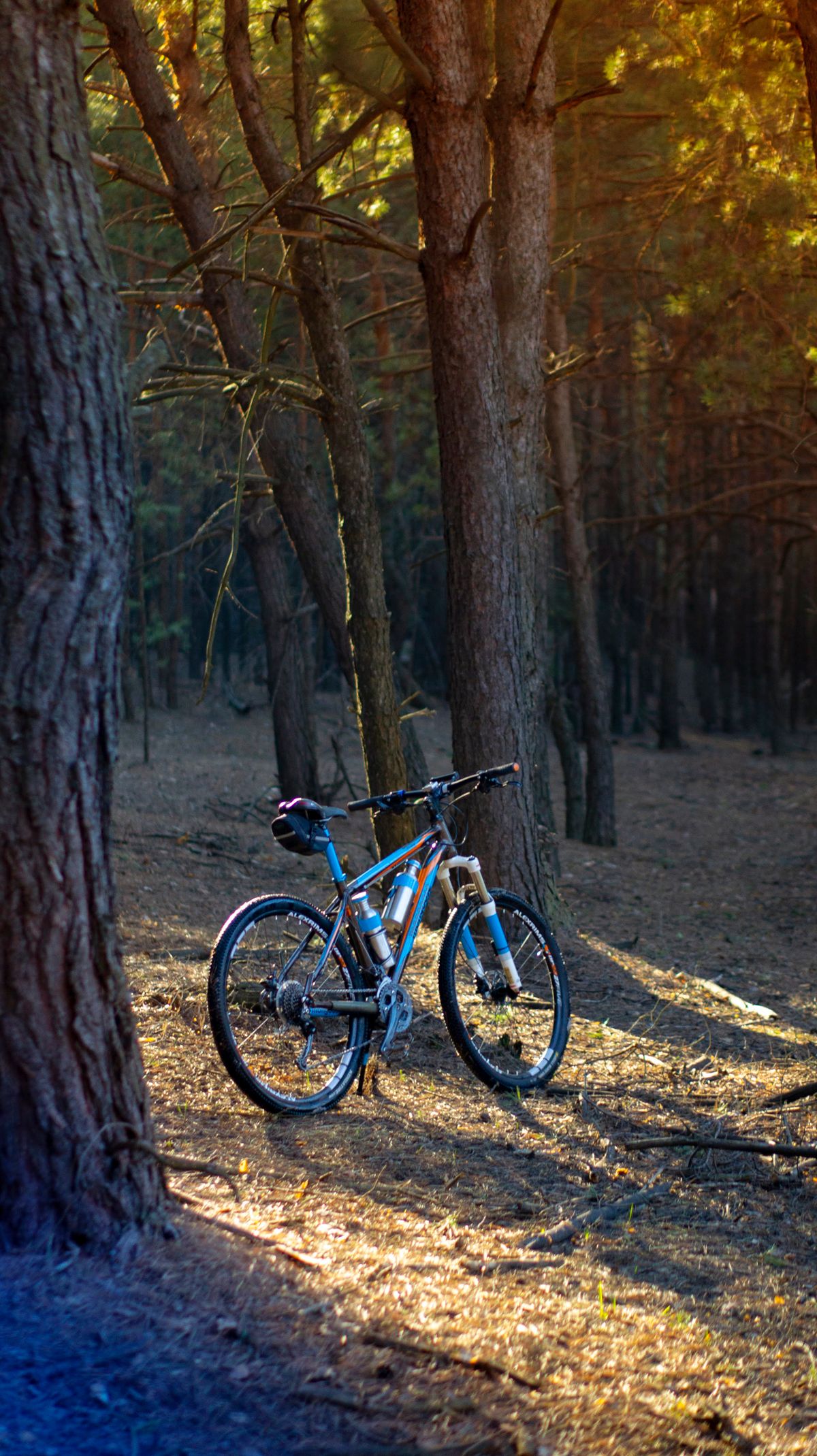
What Defines a Mountain Bike?
A mountain bike (MTB) is designed to stay controllable where other bikes give up. Three features make this possible: suspension that absorbs impacts, wide tyres with aggressive tread that grip loose surfaces, and geometry that keeps the rider stable on steep descents.
Flat, wide handlebars give leverage for precise steering. Powerful hydraulic disc brakes with large rotors provide reliable stopping power even on long alpine descents. Frames are built stronger than road frames, which is why mountain bikes typically weigh 12–16 kilograms.
Modern mountain bikes use a "dropper post" – a seatpost that lowers at the push of a lever, letting the rider move freely behind the saddle on descents.
Hardtail vs Full Suspension
Hardtail
Suspension fork at the front, rigid frame at the rear. Lighter, cheaper, more efficient when pedalling and easier to maintain. The ideal first mountain bike and the standard choice for cross-country riding on moderate trails.
Best for: beginners, XC racing, forest paths, tighter budgets
Full Suspension ("Fully")
Suspension at both wheels. More traction, more comfort and much more control on rough, fast or steep terrain – at the cost of weight, price and maintenance. Travel ranges from 120 mm (trail) to 200 mm (downhill).
Best for: technical trails, enduro, bike parks, alpine tours
The Main MTB Disciplines
Cross-Country (XC)
Fast riding on rolling terrain with climbs and moderate descents. XC is an Olympic discipline; bikes are light (10–12 kg) with around 100–120 mm of travel.
Trail / All-Mountain
The most popular category for hobby riders: one bike that climbs well and descends confidently, with 130–150 mm of travel.
Enduro
Races are timed on the descents only, so bikes (160–180 mm travel) prioritise downhill capability while remaining pedalable uphill.
Downhill (DH)
Pure gravity racing on the steepest, roughest tracks. 200 mm of travel, dual-crown forks and full protective gear. Riders reach the top by lift or shuttle.
Wheel Sizes: 26, 27.5 or 29 Inch?
The classic 26-inch wheel has almost disappeared from new bikes. Today most mountain bikes roll on 29-inch wheels, which carry speed better and roll over obstacles more smoothly. The smaller 27.5-inch size survives on playful trail bikes and smaller frame sizes; some enduro bikes mix both ("mullet" setup: 29 front, 27.5 rear).
Mountain Biking in Germany
Germany's low mountain ranges are ideal MTB country. The Harz offers the Volksbank Arena with over 2,200 km of signposted routes. The Black Forest combines long climbs with flowing singletrack, and Winterberg in the Sauerland hosts one of Europe's best-known bike parks.
In the south, the Bavarian Alps and the Allgäu deliver genuine alpine riding, and many riders start the classic Transalp crossing to Lake Garda from Bavaria. Cross-country and downhill racing also have a solid competitive scene under the German Cycling Federation – more on our cycling sport page.
Is a Mountain Bike Right for You?
Choose a mountain bike if you…
- ride forest trails, singletrack or mountains
- value control and robustness over speed
- want to explore bike parks or alpine tours
- enjoy technical riding challenges
Consider another type if you…
- ride mostly on asphalt – see road bikes
- commute daily with luggage – see city bikes
- want motor assistance on climbs – see e-MTBs